
Team Size: 1
Team Size: 1
Team Size: 1
Role: Designer, Writer, Artist
Role: Designer, Writer, Artist
Role: Designer, Writer, Artist
Development Cycle: 3 Months
Development Cycle: 3 Months
Development Cycle: 3 Months
Software: Adobe InDesign
Software: Adobe InDesign
Software: Adobe InDesign
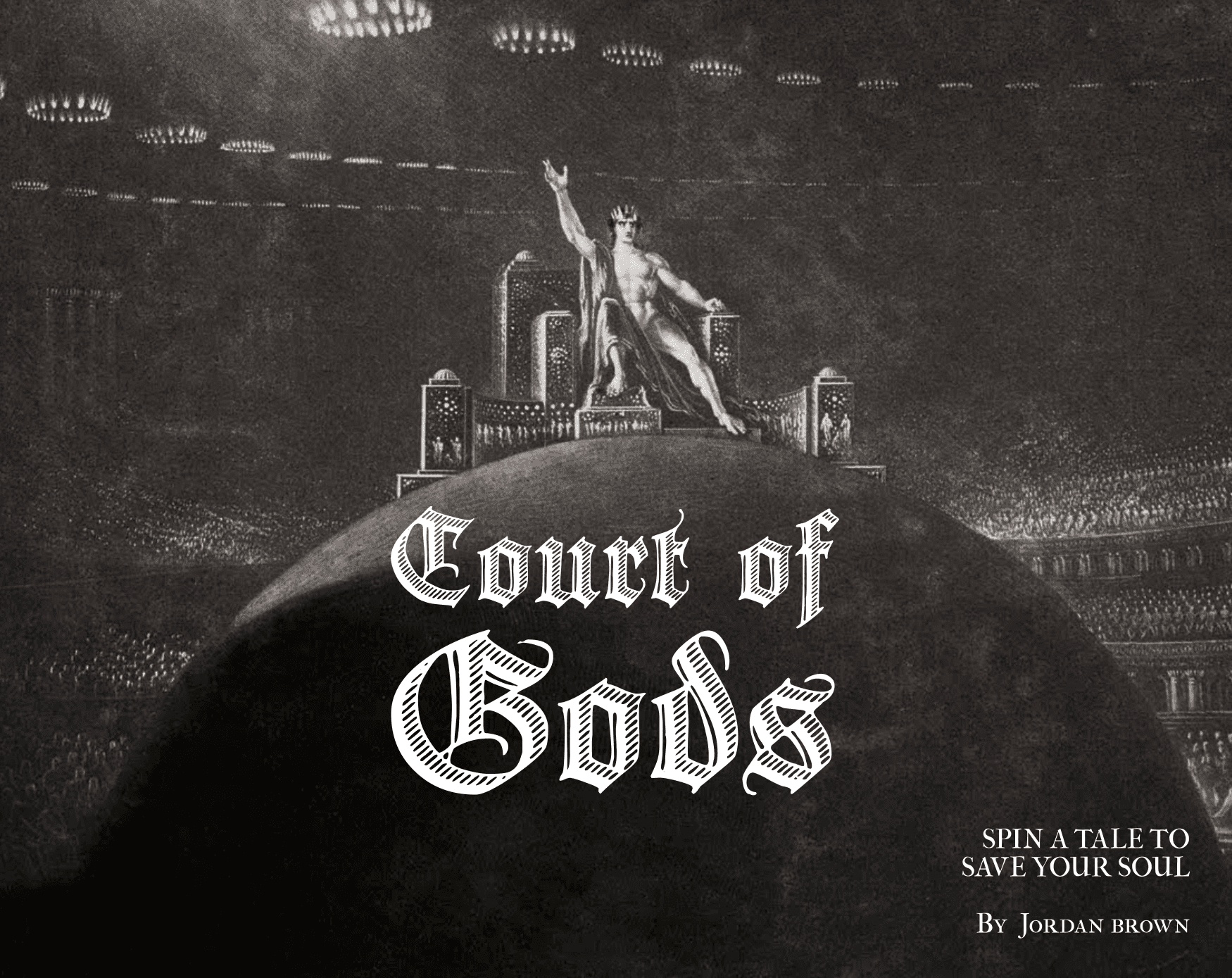
Description: Court of Gods is a tabletop role-playing party game where a convicted criminal weaves together a short story that convinces their Gods to spare their soul.
Description: Court of Gods is a tabletop role-playing party game where a convicted criminal weaves together a short story that convinces their Gods to spare their soul.
Description: Court of Gods is a tabletop role-playing party game where a convicted criminal weaves together a short story that convinces their Gods to spare their soul.
Core Contributions:
Core Contributions:
Core Contributions:
Brainstormed, prototyped, and conducted live playtesting for each major iteration of the game
Brainstormed, prototyped, and conducted live playtesting for each major iteration of the game
Brainstormed, prototyped, and conducted live playtesting for each major iteration of the game
Translated the game from a Google document to an organized, easily digestible PDF with a font, art, and formatting that reflects its fantasy setting and religion-focused flavor using free online resources and Adobe InDesign
Translated the game from a Google document to an organized, easily digestible PDF with a font, art, and formatting that reflects its fantasy setting and religion-focused flavor using free online resources and Adobe InDesign
Translated the game from a Google document to an organized, easily digestible PDF with a font, art, and formatting that reflects its fantasy setting and religion-focused flavor using free online resources and Adobe InDesign
Found and cleaned up public domain art assets to enhance the final PDFs charm and overall appeal
Found and cleaned up public domain art assets to enhance the final PDFs charm and overall appeal
Found and cleaned up public domain art assets to enhance the final PDFs charm and overall appeal
Post Mortem
Post Mortem
Post Mortem
What went well:
What went well:
What went well:
Stripped away the non-essential mechanics and systems of the original version to solely focus development on enhancing story creation and role-playing.
Stripped away the non-essential mechanics and systems of the original version to solely focus development on enhancing story creation and role-playing.
Stripped away the non-essential mechanics and systems of the original version to solely focus development on enhancing story creation and role-playing.
Dice rolls provided players with enough scaffolding to create entertaining stories off the cuff.
Dice rolls provided players with enough scaffolding to create entertaining stories off the cuff.
Dice rolls provided players with enough scaffolding to create entertaining stories off the cuff.
Created an easily digestible and artistically cohesive PDF containing the entirety of the game.
Created an easily digestible and artistically cohesive PDF containing the entirety of the game.
Created an easily digestible and artistically cohesive PDF containing the entirety of the game.
The game's over-the-top formality, combined with the absurd dice table, pushed players toward comedic, light-hearted play sessions.
The game's over-the-top formality, combined with the absurd dice table, pushed players toward comedic, light-hearted play sessions.
The game's over-the-top formality, combined with the absurd dice table, pushed players toward comedic, light-hearted play sessions.
What went wrong:
What went wrong:
What went wrong:
Players unfamiliar with tabletop role-playing games struggled to come up with stories about their characters within the game world.
Players unfamiliar with tabletop role-playing games struggled to come up with stories about their characters within the game world.
Players unfamiliar with tabletop role-playing games struggled to come up with stories about their characters within the game world.
The diction in a few of the dice tables was too esoteric, leading to confusion.
The diction in a few of the dice tables was too esoteric, leading to confusion.
The diction in a few of the dice tables was too esoteric, leading to confusion.
What I learned:
What I learned:
What I learned:
Simple games without complex systems and beautiful handcrafted art can be successful if they juice their core mechanics and find their target audience.
Simple games without complex systems and beautiful handcrafted art can be successful if they juice their core mechanics and find their target audience.
Simple games without complex systems and beautiful handcrafted art can be successful if they juice their core mechanics and find their target audience.
Adobe InDesign basics.
Adobe InDesign basics.
Adobe InDesign basics.
Reflection
I could argue that Court of Gods is the most important game I've ever made. I first developed it while taking Foundations of Game Design in the Spring 2022 semester. I had recently switched my major from History and Media Studies to Game Design; my imposter syndrome was at an all-time high. While I enjoyed the class's first two projects, nothing clicked until I playtested Court of Gods. I remember a number of my classmates having fun - genuinely enjoying something I had created with my own two hands. At that moment, I realized I had made the right decision and found my calling as a designer. Since then, I've always wanted to go back and refine Court of Gods, as I've always felt that it has the potential to go from good to excellent. I was incredibly excited about the opportunity to revise it while taking GAME 4000 (Tales from the Table) during my final semester at Northeastern University. My first step in revising Court of Gods was to refresh myself on its rules and mechanics. I was surprised to find that I had intended for it to be a competition: each player would play two Petitions as the Commoner (revised to Damned) and six as a Deity (revised to God). Similar to Apples To Apples, where the first player to win some number of rounds wins, the first player to receive two innocent verdicts as the Commoner is declared the winner. The most glaring issue with this mechanic is that it conflicts with the game's core experience: creating and telling silly stories. If players were to value winning over telling stories, they might repress their creative instincts as the Commoner and focus on tailoring their stories to the Deities. At the same time, a Deity might never judge a Commoner innocent to prevent their opponents from getting close to a win. It's clear to me that I had a glaringly narrow idea of what a game needs to be successful: winners, losers, competition, and many other elements found in today's most popular multiplayer games. In reality, a successful game might have a single mechanic, strong theming, and a few pieces of art. As long as a game's elements support each other to build a compelling experience for players, it can find success with the right audience. With this in mind, I decided to focus on stripping away each element of Court of Gods that didn't scaffold or amplify the storytelling focus, adding and reworking the dice tables, and refining its nouns and verbs. Sidenote: I also discovered that I love writing little paragraphs that describe a game for players using diction that reflects its narrative and setting. Here's the one I wrote for Court of Gods: "Your countrymen of Orithena have looked upon your face, heard your words, and judged you guilty. While the justiciars would gladly hasten you on your way to the hallowed Halls of Halikarn, your soul is not theirs to judge. Prostrate yourself before three of the gods who rule Orithena and plead your case. Tell them your story and convince them to spare your soul so you may leave the Court of Gods alive." Overall, I was delighted with how the playtests went. Players quickly and seamlessly settled into their roles as the Damned or the Gods, and the dice rolls seemed to scaffold players into their roles successfully. One comment I got is how each Petition has the potential to build on the world the players are creating through their stories. Every time a player generates a new Damned or a God, they add a bit of detail to the world. With enough time, players could map out Orithena or create recurring NPCs. I could also remove the character names from the victim table and allow players to write their own to amplify the world creation facet. Someone also suggested that I could add a punishment table that the Gods could use if they judge the Damned Innocent with Penance. If the punishments are so grotesque that they become absurd, the table could add a more concrete comedic element to the end of each Petition.
Reflection
I could argue that Court of Gods is the most important game I've ever made. I first developed it while taking Foundations of Game Design in the Spring 2022 semester. I had recently switched my major from History and Media Studies to Game Design; my imposter syndrome was at an all-time high. While I enjoyed the class's first two projects, nothing clicked until I playtested Court of Gods. I remember a number of my classmates having fun - genuinely enjoying something I had created with my own two hands. At that moment, I realized I had made the right decision and found my calling as a designer. Since then, I've always wanted to go back and refine Court of Gods, as I've always felt that it has the potential to go from good to excellent. I was incredibly excited about the opportunity to revise it while taking GAME 4000 (Tales from the Table) during my final semester at Northeastern University. My first step in revising Court of Gods was to refresh myself on its rules and mechanics. I was surprised to find that I had intended for it to be a competition: each player would play two Petitions as the Commoner (revised to Damned) and six as a Deity (revised to God). Similar to Apples To Apples, where the first player to win some number of rounds wins, the first player to receive two innocent verdicts as the Commoner is declared the winner. The most glaring issue with this mechanic is that it conflicts with the game's core experience: creating and telling silly stories. If players were to value winning over telling stories, they might repress their creative instincts as the Commoner and focus on tailoring their stories to the Deities. At the same time, a Deity might never judge a Commoner innocent to prevent their opponents from getting close to a win. It's clear to me that I had a glaringly narrow idea of what a game needs to be successful: winners, losers, competition, and many other elements found in today's most popular multiplayer games. In reality, a successful game might have a single mechanic, strong theming, and a few pieces of art. As long as a game's elements support each other to build a compelling experience for players, it can find success with the right audience. With this in mind, I decided to focus on stripping away each element of Court of Gods that didn't scaffold or amplify the storytelling focus, adding and reworking the dice tables, and refining its nouns and verbs. Sidenote: I also discovered that I love writing little paragraphs that describe a game for players using diction that reflects its narrative and setting. Here's the one I wrote for Court of Gods: "Your countrymen of Orithena have looked upon your face, heard your words, and judged you guilty. While the justiciars would gladly hasten you on your way to the hallowed Halls of Halikarn, your soul is not theirs to judge. Prostrate yourself before three of the gods who rule Orithena and plead your case. Tell them your story and convince them to spare your soul so you may leave the Court of Gods alive." Overall, I was delighted with how the playtests went. Players quickly and seamlessly settled into their roles as the Damned or the Gods, and the dice rolls seemed to scaffold players into their roles successfully. One comment I got is how each Petition has the potential to build on the world the players are creating through their stories. Every time a player generates a new Damned or a God, they add a bit of detail to the world. With enough time, players could map out Orithena or create recurring NPCs. I could also remove the character names from the victim table and allow players to write their own to amplify the world creation facet. Someone also suggested that I could add a punishment table that the Gods could use if they judge the Damned Innocent with Penance. If the punishments are so grotesque that they become absurd, the table could add a more concrete comedic element to the end of each Petition.
Reflection
I could argue that Court of Gods is the most important game I've ever made. I first developed it while taking Foundations of Game Design in the Spring 2022 semester. I had recently switched my major from History and Media Studies to Game Design; my imposter syndrome was at an all-time high. While I enjoyed the class's first two projects, nothing clicked until I playtested Court of Gods. I remember a number of my classmates having fun - genuinely enjoying something I had created with my own two hands. At that moment, I realized I had made the right decision and found my calling as a designer. Since then, I've always wanted to go back and refine Court of Gods, as I've always felt that it has the potential to go from good to excellent. I was incredibly excited about the opportunity to revise it while taking GAME 4000 (Tales from the Table) during my final semester at Northeastern University. My first step in revising Court of Gods was to refresh myself on its rules and mechanics. I was surprised to find that I had intended for it to be a competition: each player would play two Petitions as the Commoner (revised to Damned) and six as a Deity (revised to God). Similar to Apples To Apples, where the first player to win some number of rounds wins, the first player to receive two innocent verdicts as the Commoner is declared the winner. The most glaring issue with this mechanic is that it conflicts with the game's core experience: creating and telling silly stories. If players were to value winning over telling stories, they might repress their creative instincts as the Commoner and focus on tailoring their stories to the Deities. At the same time, a Deity might never judge a Commoner innocent to prevent their opponents from getting close to a win. It's clear to me that I had a glaringly narrow idea of what a game needs to be successful: winners, losers, competition, and many other elements found in today's most popular multiplayer games. In reality, a successful game might have a single mechanic, strong theming, and a few pieces of art. As long as a game's elements support each other to build a compelling experience for players, it can find success with the right audience. With this in mind, I decided to focus on stripping away each element of Court of Gods that didn't scaffold or amplify the storytelling focus, adding and reworking the dice tables, and refining its nouns and verbs. Sidenote: I also discovered that I love writing little paragraphs that describe a game for players using diction that reflects its narrative and setting. Here's the one I wrote for Court of Gods: "Your countrymen of Orithena have looked upon your face, heard your words, and judged you guilty. While the justiciars would gladly hasten you on your way to the hallowed Halls of Halikarn, your soul is not theirs to judge. Prostrate yourself before three of the gods who rule Orithena and plead your case. Tell them your story and convince them to spare your soul so you may leave the Court of Gods alive." Overall, I was delighted with how the playtests went. Players quickly and seamlessly settled into their roles as the Damned or the Gods, and the dice rolls seemed to scaffold players into their roles successfully. One comment I got is how each Petition has the potential to build on the world the players are creating through their stories. Every time a player generates a new Damned or a God, they add a bit of detail to the world. With enough time, players could map out Orithena or create recurring NPCs. I could also remove the character names from the victim table and allow players to write their own to amplify the world creation facet. Someone also suggested that I could add a punishment table that the Gods could use if they judge the Damned Innocent with Penance. If the punishments are so grotesque that they become absurd, the table could add a more concrete comedic element to the end of each Petition.
Reflection
I could argue that Court of Gods is the most important game I've ever made. I first developed it while taking Foundations of Game Design in the Spring 2022 semester. I had recently switched my major from History and Media Studies to Game Design; my imposter syndrome was at an all-time high. While I enjoyed the class's first two projects, nothing clicked until I playtested Court of Gods. I remember a number of my classmates having fun - genuinely enjoying something I had created with my own two hands. At that moment, I realized I had made the right decision and found my calling as a designer. Since then, I've always wanted to go back and refine Court of Gods, as I've always felt that it has the potential to go from good to excellent. I was incredibly excited about the opportunity to revise it while taking GAME 4000 (Tales from the Table) during my final semester at Northeastern University. My first step in revising Court of Gods was to refresh myself on its rules and mechanics. I was surprised to find that I had intended for it to be a competition: each player would play two Petitions as the Commoner (revised to Damned) and six as a Deity (revised to God). Similar to Apples To Apples, where the first player to win some number of rounds wins, the first player to receive two innocent verdicts as the Commoner is declared the winner. The most glaring issue with this mechanic is that it conflicts with the game's core experience: creating and telling silly stories. If players were to value winning over telling stories, they might repress their creative instincts as the Commoner and focus on tailoring their stories to the Deities. At the same time, a Deity might never judge a Commoner innocent to prevent their opponents from getting close to a win. It's clear to me that I had a glaringly narrow idea of what a game needs to be successful: winners, losers, competition, and many other elements found in today's most popular multiplayer games. In reality, a successful game might have a single mechanic, strong theming, and a few pieces of art. As long as a game's elements support each other to build a compelling experience for players, it can find success with the right audience. With this in mind, I decided to focus on stripping away each element of Court of Gods that didn't scaffold or amplify the storytelling focus, adding and reworking the dice tables, and refining its nouns and verbs. Sidenote: I also discovered that I love writing little paragraphs that describe a game for players using diction that reflects its narrative and setting. Here's the one I wrote for Court of Gods: "Your countrymen of Orithena have looked upon your face, heard your words, and judged you guilty. While the justiciars would gladly hasten you on your way to the hallowed Halls of Halikarn, your soul is not theirs to judge. Prostrate yourself before three of the gods who rule Orithena and plead your case. Tell them your story and convince them to spare your soul so you may leave the Court of Gods alive." Overall, I was delighted with how the playtests went. Players quickly and seamlessly settled into their roles as the Damned or the Gods, and the dice rolls seemed to scaffold players into their roles successfully. One comment I got is how each Petition has the potential to build on the world the players are creating through their stories. Every time a player generates a new Damned or a God, they add a bit of detail to the world. With enough time, players could map out Orithena or create recurring NPCs. I could also remove the character names from the victim table and allow players to write their own to amplify the world creation facet. Someone also suggested that I could add a punishment table that the Gods could use if they judge the Damned Innocent with Penance. If the punishments are so grotesque that they become absurd, the table could add a more concrete comedic element to the end of each Petition.